AI isn't killing personal brands. It's exposing the ones that were never really built on thinking. Use AI for the mechanics (ideas, outlines, repurposing, scheduling and analysis), but keep the parts that prove you've lived something: specific decisions, real stories and opinions only you hold. That's the line between a brand and a content feed.
Updated 14 November 2026 · By Jerry Jose, LinkedIn Top Voice and founder of SocialJJ
The machines aren't replacing thought leaders. They're revealing which ones were never really thinking.
I was scrolling social channels on a Saturday afternoon, procrastinating on a brief I'd rather not write, when I noticed something I couldn't immediately name.
Post after post looked correct. The formatting was clean. The insights were structured. The calls to action were there. Someone's "3 lessons from my startup failure", then another person's "why most marketers get positioning wrong", then a discussion on authentic leadership with a sunset photo. Everything was in order. Nothing was alive.
I realised I'd been scrolling for four minutes without stopping once. Not because the content was bad. Because it was indistinguishable. A feed full of professionally competent statements from people I couldn't picture saying them out loud.
That's the uncanny valley of professional content. It passes the sniff test. It just doesn't smell like anyone.
How much LinkedIn content is AI-generated now?
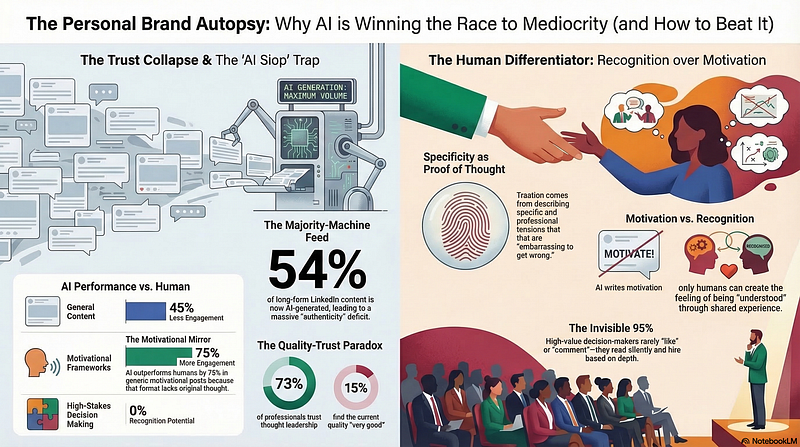
Most of it. Originality.ai estimated that 54% of long-form LinkedIn posts were likely AI-generated as of October 2024, counting posts written or heavily edited by AI (Originality.ai). By July 2026, its analysis of 5,000 public posts put the figure at 81%: 4,061 of 5,000 were likely AI (Originality.ai). The platform built on professional identity has quietly become majority-machine.
The industry noticed. The ANA named two Marketing Words of the Year for 2025: "Agentic AI" and "Authenticity" (ANA). The technology flooding our feeds, and the thing we're afraid of losing to it, in the same announcement. Which is either hopeful or ironic, depending on your mood. And people had already invented a word for what they were scrolling through: AI slop.
Does AI-generated content perform worse on LinkedIn?
It depends on the genre, and that nuance is the uncomfortable part. In Originality.ai's 2025 analysis of 3,368 long-form posts from 99 influential profiles, likely-AI posts in the leadership and inspiration category got 75% more engagement than human-written ones. In other categories, human posts did better.
Sit with that for a second. Motivational content. Leadership inspiration. The "here are my three principles for success" format. In that genre, the machines don't underperform. They win.
If your personal brand is inspiration-forward and framework-heavy, the machines have already outscaled you. Not because they're better at thinking. Because that format never required thinking in the first place.
What this tells us isn't that AI is getting more human. It tells us a lot of motivational thought leadership was never particularly human to begin with. The format was already abstracted from real experience, so the machine fit right in.
This isn't comfortable to write. I've written posts in that format. You probably have too. We were performing a genre that turned out to have no fingerprints.
Is thought leadership still worth it in the age of AI?
More than ever, if it's real. In the 2024 Edelman–LinkedIn B2B Thought Leadership Impact Report, which surveyed nearly 3,500 management-level professionals, 73% said an organisation's thought leadership is a more trustworthy basis for judging its capabilities than its marketing materials (Edelman–LinkedIn).
Buyers trust thought leadership. Feeds are full of thought leadership that sounds like everyone else's. That gap is the opportunity. AI has flooded the zone with competent, forgettable content, so the bar for being memorable has never been lower, as long as you have something real to say.
The people gaining traction now aren't posting more or using better hooks. They're writing about things that would be embarrassing to get wrong: specific decisions they regret, a campaign that flopped in a way that revealed something true, a client conversation that changed how they see their whole category. You can't prompt your way into that. It requires having lived something.
Who is actually reading your content?
Mostly people you can't see. The same Edelman–LinkedIn research found that, at any given moment, 95% of business clients aren't actively looking to buy (Edelman–LinkedIn). They aren't commenting or liking. They read, close the tab and file something away for later.
What you think is underperforming content might be actively working. You just can't see where, or on whom, until someone emails you out of nowhere six months later and says they've been following your writing.
I've had that email more than once, from people I'd never have guessed were paying attention. A procurement lead who brought up something I'd written about attribution in our first call, as if I'd said it at dinner. A founder who'd been reading for eight months before she ever reached out.
The metrics we use to judge whether personal brand content is "working" measure the wrong audience. The people who like and comment are often not the people who buy, hire or refer.
What should you use AI for in personal branding, and what shouldn't you?
Use AI for the mechanics. Keep the thinking.
| Use AI for… | Don't use AI for… |
|---|---|
| Brainstorming angles and breaking writer's block | Deciding what you actually believe |
| Outlines and first-draft structure | Your stories, mistakes and lessons |
| Turning one long piece into several short posts | Opinions you haven't formed yourself |
| Scheduling, formatting and checking hooks | Replying to people as if it were you |
| Analysing what's working in your analytics | Claiming results, numbers or experiences you don't have |
| Tightening your profile copy | Generating thoughts you then put your name on |
Practical ways to keep AI on the right side of that line:
- Start from your own notes. Voice memos, client conversations and things you got wrong are raw material AI can't invent.
- Edit for specifics. If a sentence could appear in anyone's post, replace it with a detail from your own work.
- Check the facts. AI states things confidently. Verify any statistic against its original source before you publish.
- Check how it reads. My free LinkedIn Post Analyzer gives every draft an AI-risk score, flagging uniform sentence lengths, repetitive vocabulary and heavy em-dash use.
- Protect your privacy. Don't paste client or personal data into tools whose data policies you haven't checked.
For how I use AI tools across my wider marketing work, see How to Use Claude Code for Marketing.
What is a personal brand now?
I want to say something harder to hear than "be more authentic". A personal brand is not a content calendar. It's not a niche statement or a signature framework you repeat until people associate it with you.
A personal brand is a record of how you think.
The professionals cutting through now write about the texture of their decisions. Not "here's what I learned from failure" as a genre, but "here's the moment I realised I'd been wrong about this for three years, and what I got wrong about why". They write about tensions they haven't resolved, and treat public writing less like a highlight reel and more like a working document.
In my work with content strategy clients, the posts that brought the most meaningful inbound (real replies and business conversations, not impressions) were the ones that described a specific professional problem in enough detail that readers felt someone finally understood their situation. Not inspiration. Recognition.
The content that builds trust doesn't make people feel motivated. It makes them feel understood. Those are completely different outcomes. And only one of them requires a human.
AI can write motivation. It can't write recognition. It can't write the specific discomfort of a situation you've been in, from the inside, without softening the parts that make it complicated. That's the line worth protecting.
An honest ending, not a pep talk
I've used AI to write content. Not to replace my thinking, I'd tell myself, but to move faster: a first draft, a structure to react to. Mostly that was true. Sometimes it wasn't. Sometimes I read back something I'd "edited" from an AI draft and couldn't tell which sentences were mine. That's the edge I'm more careful about now.
The interesting question isn't "AI content bad, human content good". It's about the thinking that comes before the writing, and who actually did it. Using AI to help put a thought you genuinely had into words is one thing. Using AI to generate thoughts you then attach your name to is something else.
AI didn't create the hollow format. It just made the hollowness visible.
Here's what I keep coming back to: if someone replaced everything you've posted in the last six months with AI-generated content in your voice and style, would anyone notice?
Would you?
Frequently asked questions
Is AI killing personal branding?
No. AI is flooding feeds with competent, generic content, which makes generic personal brands easier to replace and real ones easier to spot. Brands built on specific experience, opinions and stories are harder to copy than ever.
How much LinkedIn content is AI-generated?
Originality.ai estimated that 54% of long-form LinkedIn posts were likely AI-generated as of October 2024, rising to 81% in its July 2026 analysis of 5,000 public posts. Both figures count posts written or heavily edited by AI.
Should I use AI to build my personal brand?
Yes, for the mechanics: brainstorming, outlines, repurposing, scheduling, formatting and analysing performance. Don't use it to generate the opinions, stories and lessons your brand is built on, because those have to come from you.
Does AI-generated content perform worse on LinkedIn?
It depends on the genre. Originality.ai's 2025 analysis found AI-written leadership and inspiration posts got more engagement than human ones, while human-written posts did better in other categories. Specific, experience-based content is where humans still have the edge.
How do I keep my personal brand authentic when using AI?
Start from your own notes and experiences, replace generic sentences with specifics from your work, verify every statistic, and check your drafts for AI-sounding patterns before publishing. If you couldn't say it out loud as your own view, don't post it.
What are the risks of using AI for personal branding?
Sounding like everyone else, publishing confident but wrong facts, losing your own voice over time, and exposing private client or personal data to AI tools. All of them are manageable if you keep the thinking and final edit yourself.