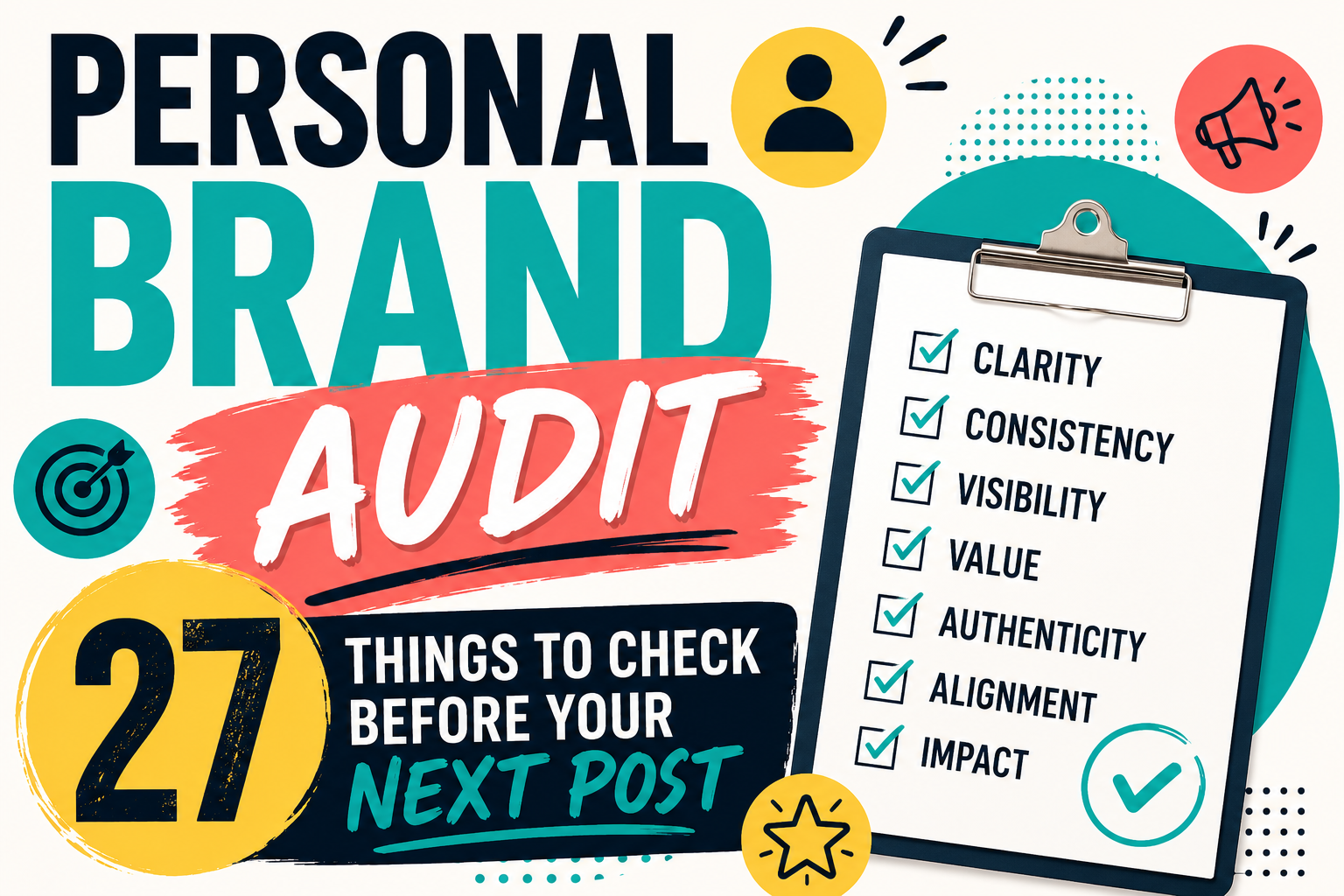
A personal brand audit is a structured review of how you show up online: your profile, content, positioning and visibility, and the gap between what you say and what your audience experiences. This one has 27 checks under 7 traits. Score each from 1 to 5, out of 135 in total. Below 95 means your foundation, not your content, is the bottleneck.
Updated 14 November 2026 · By Jerry Jose, LinkedIn Top Voice and founder of SocialJJ
Posting more is not a strategy. Posting from a broken foundation just scales the problem.
Before you write your next LinkedIn or X post, run this audit. It takes about 20 minutes. It's the same checklist I use when I audit creator profiles for 1:1 clients. In those audits, most people find several things that need fixing on the first pass, and those fixes do more than a week of new content.
What are the 7 traits of a strong personal brand?
Every personal brand that works can be scored on seven traits. The 27 checks below sit under them.
| Trait | The question it answers | Checks |
|---|---|---|
| Clarity | Can people instantly tell what you do and who you help? | 1 to 4 |
| Consistency | Do your posts, profile and visuals tell the same story? | 5 to 8 |
| Visibility | Can the right people find and recognise you? | 9 to 13 |
| Value | Does your content move someone forward, or just fill a feed? | 14 to 17 |
| Authenticity | Is there proof you've done what you claim? | 18 to 20 |
| Alignment | Does your behaviour outside your own posts match your message? | 21 to 23 |
| Impact | Does any of this turn into outcomes you can measure? | 24 to 27 |
How do you score a personal brand audit?
Score each check from 1 (missing) to 5 (strong). Anything below 3 goes on your fix list. Add up all 27 for a total out of 135:
| Total score | What it means |
|---|---|
| Above 105 | Healthy and ready to scale. Put your energy into content and distribution |
| 95 to 105 | The foundation is there, but it's leaking attention or conversions in two or three specific places |
| Below 95 | The foundation is the bottleneck. Fix it before producing more content |
To find your weakest trait, average your scores within each of the seven sections. Your lowest average is the trait to fix first.
Clarity: can people tell what you do? (checks 1 to 4)
If a stranger can't explain what you do after 10 seconds on your profile, nothing else in this audit matters.
| # | Check | Score 5 if… | Score 1 if… |
|---|---|---|---|
| 1 | Headline | It states who you help and the outcome you deliver: "Helping B2B founders turn LinkedIn into a pipeline source" | It's just your job title: "Senior Marketing Manager" |
| 2 | The "what do you do" answer | You can explain it in one sentence and a stranger gets it | Your answer takes more than 12 seconds |
| 3 | Niche audience | It's specific: "bootstrapped SaaS founders going from $10K to $100K MRR" | It's everyone: "I help entrepreneurs" |
| 4 | Transformation promise | You can write what your audience looks like before and after working with you | You can't describe either |
Consistency: do you tell one story? (checks 5 to 8)
Clarity tells people what you do. Consistency proves you actually do it.
| # | Check | Score 5 if… | Score 1 if… |
|---|---|---|---|
| 5 | Pillar topics | Your last 30 posts cover three to five themes | They cover 12 or more themes |
| 6 | Tone | Your bio and your last five posts sound like the same person | Your bio is corporate and your posts are casual, or the reverse |
| 7 | Visuals | Carousels and images use the same two fonts and two colours | Every visual looks like a different brand |
| 8 | Posting cadence | You've posted about three times a week, every week, for the last 14 days | A burst of posts followed by silence |
Visibility: can the right people find you? (checks 9 to 13)
You can be clear and consistent and still be invisible if these basics are off.
| # | Check | Score 5 if… | Score 1 if… |
|---|---|---|---|
| 9 | Profile photo | A clear face, eye contact, a neutral or branded background, shot from the chest up, taken in the last two years | Sunglasses, a cropped group photo, or a photo that no longer looks like you |
| 10 | Banner | It shows what you do and who you help: your offer, a result or a call to action | Generic mountains, a quote graphic, or the default background |
| 11 | Custom URL | linkedin.com/in/yourname | linkedin.com/in/yourname-1234567 |
| 12 | Contact info | Email, website and booking link are visible without digging | People have to search three menus to reach you |
| 13 | Hook strength | The first two lines of your posts are specific, surprising or contrarian | "Here are 5 tips" |
Value: does your audience get something? (checks 14 to 17)
| # | Check | Score 5 if… | Score 1 if… |
|---|---|---|---|
| 14 | About section, first lines | The lines before "see more" lead with the problem you solve or the result you deliver | They start with your career origin story |
| 15 | Featured section | The first items are your best assets: top post, lead magnet, newsletter sign-up and service page, refreshed monthly | Empty, or filled with old certificates |
| 16 | Format mix | Your feed mixes personal stories, frameworks, opinions and tactical posts | Every post is the same type |
| 17 | Call to action | Every post has a job: comment, click, share, reply or DM | Your last 10 posts ended with no ask |
Authenticity: where's the proof? (checks 18 to 20)
Claims without receipts kill trust faster than anything else on this list.
| # | Check | Score 5 if… | Score 1 if… |
|---|---|---|---|
| 18 | Differentiator | A method, perspective, experience or result that's hard to copy | "Hard work" and "passion" |
| 19 | Proof of expertise | Numbers, names, outcomes, screenshots and testimonials, pinned in Featured and woven into posts | Claims with no receipts |
| 20 | DM hygiene | Most of your last 10 outbound messages were personalised openers | More than half were generic pitches |
Alignment: do your actions match your message? (checks 21 to 23)
What you do outside your own posts matters as much as what you publish.
| # | Check | Score 5 if… | Score 1 if… |
|---|---|---|---|
| 21 | Comment activity | You leave thoughtful comments on five to ten posts in your niche before publishing your own | You only show up to post |
| 22 | Replies to your comments | You reply to comments on your posts within about an hour, while the conversation is fresh | Comments go unanswered |
| 23 | Network curation | Most of your last 50 connections are your target audience or peers | They're random, so your feed and reach are diluted |
Impact: does it turn into results? (checks 24 to 27)
This is the part that turns visibility into revenue. Skip it and you're building an audience for someone else.
| # | Check | Score 5 if… | Score 1 if… |
|---|---|---|---|
| 24 | Lead magnet | A stranger can find a free download or sign-up link on your profile in under 10 seconds | There isn't one |
| 25 | Email capture | You turn followers into email subscribers every week | All your audience lives on someone else's platform |
| 26 | Service page | Someone can book or buy from you within two clicks of your profile | It takes more than two clicks, or there's no page |
| 27 | Tracking | You know which post brought which client, even in a simple spreadsheet | "I think it was that post a few weeks ago" |
What should you do with your audit results?
- Pick your five lowest scores.
- Fix them this week, before you publish anything new.
- Re-score those five checks once they're done.
- Run the full audit again in six months, with a 15-minute spot check every quarter.
A clean profile with strong positioning beats a noisy one with weak positioning, however often the noisy one posts. I see it in almost every audit I run.
For a faster, automated read, the free Personal Brand Scorecard scores you out of 100 across seven pillars in about five minutes, and the LinkedIn Profile Audit scores your profile section by section. For a step-by-step guide to fixing your profile, see How to Optimize Your LinkedIn Profile.
Frequently asked questions
What is a personal brand audit?
A personal brand audit is a structured review of how you show up online: your profile, content, positioning and visibility, and the gap between what you say and what your audience experiences. It shows the specific things making your brand harder to find, trust or buy from.
How do you do a personal brand audit?
Score yourself from 1 to 5 on 27 checks across seven traits: clarity, consistency, visibility, value, authenticity, alignment and impact. Add them up out of 135, put anything below 3 on a fix list, and fix your five lowest scores first.
What's a good score on this personal brand audit?
Above 105 out of 135 is healthy and ready to scale. 95 to 105 means the foundation is there but leaking in two or three places. Below 95 means the foundation is the bottleneck, so fix it before producing more content.
How often should I audit my personal brand?
Run a full audit every six months and a 15-minute spot check every quarter. Your positioning, offers and audience shift over time, so a yearly audit is too slow if you're actively building.
How long does a personal brand audit take?
About 20 minutes to score the 27 checks, plus an hour or so to fix your five lowest-scoring items.
What's the difference between this audit and the Personal Brand Scorecard?
This audit is a manual 27-check review you score yourself out of 135. The Personal Brand Scorecard is a free 30-question online assessment that scores you out of 100 across seven pillars and gives you an archetype and action plan.