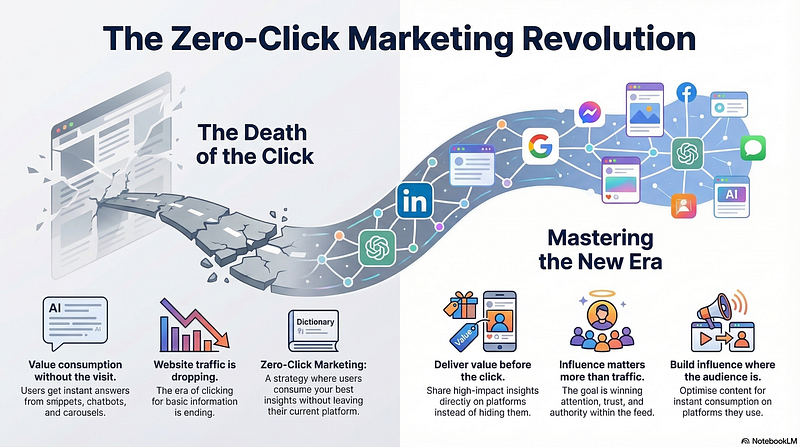
For a long time, the main goal of digital marketing was to get people to click on a website.
Marketers worked on headlines, built landing pages, ran ads, and kept an eye on conversion funnels—all of which were meant to answer one question:
How can we get more people to visit our site?
The internet is changing, though.
More and more people are getting the information they need without ever going to a website.
Many marketers now call this change “Zero-Click Marketing.”
And it’s slowly changing the way people build authority, influence, and attention online.
The Rise of No-Click Behavior
More and more digital experiences now give users answers right in the platform where they search or scroll.
Think about a few common situations.
You put a question into Google.
Instead of clicking on a website, the answer shows up right away in a featured snippet at the top of the results page.
You ask a question of an AI assistant like ChatGPT.
It makes a summary in seconds by pulling information from all over the internet, and you don’t have to go to multiple websites to do this.
Or you look through LinkedIn and see a carousel post that explains an idea in ten slides.
You get the whole idea right there in your feed.
You gained something.
But you never clicked on anything.
This is what zero-click consumption is all about.
Without leaving the platform, the user gets the information they need.
Why Platforms Like Content That Doesn’t Require Clicks
This change didn’t just happen by chance.
Platforms choose to design things this way on purpose.
When users stay inside the ecosystems of companies like Google, LinkedIn, TikTok, and YouTube for longer, these companies make more money.
Every extra minute spent on a platform makes:
- Involvement
- Money from ads
- Insights from data
- Keeping users
- External links, on the other hand, send people away.
This means that platforms now put more weight on content that gives value right on the platform.
That’s why:
- Google shows featured snippets and instant answers on its pages.
- LinkedIn prefers native content to outbound links
- Social media sites reward posts that make people want to keep scrolling.
In other words, the internet is changing from an ecosystem based on clicks to one based on attention.
The Old Way to Market: Clicks and Traffic
In the past, marketing teams focused their whole strategy on getting more people to visit their websites.
We used metrics like these to measure success:
- Views of the page
- Rates of click-through
- Length of the session
- Conversions on websites
Content marketing strategies were made to get people from social media or search engines to owned channels like websites or landing pages.
For more than ten years, this model worked well.
But it was based on one important idea:
People would click.
That idea is becoming less and less true.
The New Marketing Reality: Power and Attention
In a zero-click world, something big changes.
Value is used up before the click.
This means that the brand or creator who gives the insight gains credibility and authority right away, even if the user never goes to their website.
For marketers, the focus changes from:
“How do we get people to click?”
to
“How do we add value to places where people are already?”
This is when influence matters more than traffic.
If a brand’s posts always have useful ideas in them, people start to think of that brand as an expert.
They already know who to trust when they need help.
Examples of How Zero-Click Marketing Works
You can already see zero-click marketing on a lot of different platforms.
1. Google Featured Snippets
Google now shows quick answers right on the results page.
These snippets often give users a quick overview of the most important parts of an article without them having to go to the site.
This lowers the number of clicks, but it raises the source’s brand visibility and authority.
2. Answers made by AI
AI tools like ChatGPT and other generative search engines can quickly summarize information.
Users often get a structured answer without looking at more than one source.
This moves finding content from search results pages to AI summaries.
3. LinkedIn carousels
LinkedIn carousel posts are now one of the most powerful types of posts that don’t require a click.
Instead of sending a link to an article, creators turn insights into slides that show the whole message right in the feed.
The audience learns something useful right away, with no need to click on anything else.
4. Short Educational Content
Creators are teaching ideas in 30 to 60 seconds on sites like Instagram, TikTok, and YouTube Shorts.
The information is given right away, which often means that further research isn’t necessary.
Why This Change Is Good for Marketers
At first, it might seem like zero-click behavior is bad news.
After all, fewer clicks could mean fewer visitors.
But the larger picture tells a different story.
There are three big benefits to zero-click marketing.
1. Building trust faster
When audiences receive value instantly, trust builds faster.
People remember brands and creators that make things easy for them to understand.
2. More people can see it
When it comes to platform algorithms, native content usually does better than external links.
This means that posts that don’t require any clicks to read often get more views.
3. More power over your own and your brand’s reputation
When insights are shared directly on the platform, the creator or brand becomes the obvious source of information.
This builds recognition and authority over time.
How Marketers Should Change
Marketers need to rethink how they share content if they want to do well in the zero-click era.
Here are three changes that could be useful.
1. Don’t just share the link; share the insight.
Instead of just posting a link with little information, share the main point right in the post.
Give the audience something right away.
The link will still be there if they want to go deeper.
2. Make content that works with the platform
Every platform gives points for content that fits its style.
Some examples are:
LinkedIn slideshows
threads for learning
short videos that explain things
summaries in pictures
The goal is to make the feed’s content easy to read.
3. Pay attention to metrics that show how much influence you have
Marketers should measure more than just clicks. They should also measure:
power in the niche
These signs are often more important for building long-term brand equity.
Influence is the future of marketing.
The internet isn’t losing any content.
It is making more content than ever before, if anything.
How people use it is changing.
People want answers right away.
They want to learn without any problems.
And they like to learn directly in the platforms they already use.
This is why zero-click marketing is becoming one of the most important changes in digital strategy.
Some channels may see a drop in traffic.
But something more important is growing.
Effect.
In the end, the brands that get the most clicks won’t be the ones that win.
They will be the ones who always provide value where there is already interest.
Because of the way the internet economy works today:
Traffic may change.
But influence builds on itself.
Download my free LinkedIn Profile Audit Guide, your first step toward becoming visible, valuable, and unforgettable on LinkedIn.
Subscribe to my newsletter on SocialJJ.
Follow me on LinkedIn.
Follow me on Twitter.
Follow me on Instagram.