The machines aren’t replacing thought leaders. They’re revealing which ones were never really thinking.
I was scrolling social channels on a Saturday afternoon, procrastinating on a brief I would rather not write, when I noticed something I couldn’t immediately name.
Post after post looked correct. The formatting was clean. The insights were structured. The calls to action were there. The content includes someone’s "3 lessons from my startup failure," followed by another person’s "why most marketers get positioning wrong," and concludes with a discussion on authentic leadership accompanied by a sunset photo. Everything was in order. Nothing was alive.
I kept scrolling, waiting to feel something, and I realized I’d been scrolling for four minutes without stopping once. Not because the content was bad. Because it was indistinguishable. A feed full of professionally competent statements from people I couldn’t picture saying them out loud.
That’s the uncanny valley of professional content. It passes the sniff test. It just doesn’t smell like anyone.
Something Changed, and We All Felt It Before We Had a Name for it.
I didn’t know what I was sensing at first. I thought maybe I was burned out. Maybe the algorithm had changed again. Maybe I’d just followed too many people in the same industry.
Then I read a report that explained the feeling.
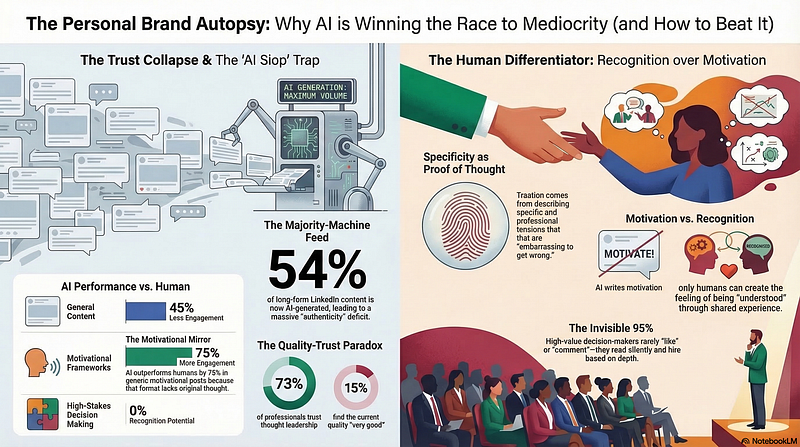
Originality. AI analyzed thousands of LinkedIn posts and found that 54% of long-form content on the platform is now AI-generated (Originality.AI, November 2024). More than half. The platform built on professional identity and human expertise had, quietly and without announcement, become majority-machine.
Around the same time, LinkedIn removed over 100 million fake accounts in 2024 alone. Fake profiles. Fake engagement. Fake reach. The infrastructure of professional authenticity was being cleaned up at scale, even as the content itself was becoming harder to trust.
What I had sensed on that Tuesday afternoon wasn’t burnout. It was a signal.
“Authenticity” became the ANA’s 2025 Marketing Word of the Year. We gave a name to the thing we were actively losing. Which is either hopeful or ironic depending on your mood.
The market knew. There’s a reason “AI slop” mentions increased ninefold on social platforms in 2025. People developed a vocabulary for what they were experiencing before the researchers had finished counting it. By the end of 2024, 59.9% of people doubted the authenticity of content they encountered online (Edelman Trust Barometer, 2024).
The trust collapse isn’t coming. It already happened. Most of us just kept posting through it.
The Data That Should Make Every “Thought Leader” Uncomfortable
Here’s where it gets strange, and I want to be precise because the nuance matters.
AI-generated content, on average, gets 45% less engagement than human-written content on LinkedIn (Originality.AI, January 2026, analysis of 3,368 posts). That sounds like good news for people who write their own stuff.
But there’s one category where AI doesn’t underperform. It outperforms. By 75%.
Motivational content. Leadership inspiration. Framework-heavy insight posts. The “here are my three principles for success” format. In that specific genre, AI-generated content outperforms human content by 75%.
Sit with that for a second.
“If your personal brand is inspiration-forward and framework-heavy, the machines have already outscaled you. Not because they’re better at thinking. Because that format never required thinking in the first place.”
What this tells us isn’t that AI is getting more human. It tells us that a significant portion of motivational thought leadership was never particularly human to begin with. The format was already abstracted away from real experience. The machine fit right in because the mold was already machine-shaped.
This is not a comfortable thing to write. I’ve written posts in that format. You probably have too. We were performing a genre that turned out to have no fingerprints.
If you’ve built a personal brand on aggregated insights, positive reframes, and “the thing most marketers get wrong about X” — the question isn’t whether AI can copy your style. It’s whether your style was ever a reliable signal of you in the first place.
The Quality Gap Nobody Is Talking About
Here’s the paradox that makes the situation interesting instead of just depressing.
Edelman and LinkedIn surveyed 3,500 B2B professionals and found that 73% of them trust thought leadership more than any other marketing format. More than ads. More than product pages. More than case studies. When decision-makers want to evaluate whether someone is worth their time, attention, or money, they read what that person thinks (Edelman–LinkedIn B2B Thought Leadership Impact Study, 2024).
And yet only 15% of those same professionals describe the thought leadership they consume as “very good.”
That gap between maximum trust and minimum quality — is the entire opportunity. AI has flooded the zone with mediocre content. The average has dropped. The noise has increased. Which means the bar for being memorable, for being the 15%, has never been structurally lower. As long as you have something real to say.
The people gaining real traction right now aren’t posting more consistently or using better hooks. They’re writing about things that would be genuinely embarrassing to get wrong. Specific decisions they regretted. A campaign that flopped in a way that revealed something true. A conversation with a client that changed how they thought about their entire category. That specificity is not something you can prompt your way into. It requires having lived something.
The Audience You Cannot See Is the One That Matters Most
One thing that quietly reshapes your thinking about all of this is that most of your real audience remains invisible to you.
The same Edelman–LinkedIn study found that 95% of finance, legal, and compliance decision-makers say thought leadership makes them more receptive to outreach. These are people who control budgets and sign contracts. They are reading your content. They are forming opinions about you. And they almost never interact with what they read.
They don’t leave comments. They don’t hit like. They don’t follow. They read, close the tab, and file something away.
“What you think is underperforming content might be actively working. You just can’t see where it’s working, or who it’s working on — until someone emails you out of nowhere six months later and says they’ve been following your writing.”
I’ve had that email. More than once. From people I’d never have guessed were paying attention. A procurement lead at a company who mentioned something I’d written about attribution in our first call like it was something I’d said at dinner. A founder who’d been reading for eight months before she ever reached out.
The metrics we use to evaluate whether personal brand content is “working” are measuring the wrong audience. The people who like and comment are often not the people who buy, hire, or refer. We’ve optimized for the visible when the invisible is where the value compounds.
Only 1% of LinkedIn users post weekly, and those posts generate 9 billion impressions. Most of the audience is watching without speaking. Which means the people you think aren’t listening might be the most important ones in the room.
What a Personal Brand Actually Is Now
I want to say something harder to hear than “be more authentic.”
A personal brand is not a content calendar. It’s not a niche statement or a signature framework you repeat until people associate it with you.
A personal brand is a record of how you think.
The professionals cutting through right now are writing about the actual texture of their decisions. Not “here’s what I learned from failure” as a genre — but “here’s the specific moment I realized I’d been wrong about this for three years, and here’s what I got wrong about why I was wrong.” They’re writing about tensions they haven’t resolved. Questions they’re still inside of. Treating their public writing less like a highlight reel and more like a working document.
That’s not the same as oversharing. It’s not vulnerability as performance. It’s specificity as proof of thought.
In working with content strategy clients, the posts that generated the most meaningful inbound — not impressions, but actual replies and real business conversations — were consistently the ones that described a specific professional problem in enough detail that the reader felt like someone finally understood their situation. Not inspiration. Recognition.
“The content that builds trust doesn’t make people feel motivated. It makes them feel understood. Those are completely different emotional outcomes. And only one of them requires a human.”
AI can write motivation. It cannot write recognition. It cannot write the specific discomfort of a situation you’ve actually been in, from the inside, without softening the parts that make it complicated.
That’s the line. That’s what’s worth protecting.
An Honest Ending, Not a Pep Talk
I’ve used AI to write content. Not to replace my thinking — I’d tell myself — but to move faster. To get a first draft out. To see how a structure might look before I committed to it.
Mostly that was true. Sometimes it wasn’t. Sometimes I read back something I’d “edited” from an AI draft and couldn’t tell which sentences were mine. That’s the edge I’m more careful about now.
The interesting question isn’t “AI content bad, human content good.” The interesting question is about the thinking that precedes the writing, and who actually did it.
Using AI to help articulate a thought you genuinely had is one thing. Using AI to generate thoughts you then attach your name to is something else. The difference isn’t in the output. It’s in whether anything real about how you see the world is on the page.
AI didn’t create the hollow format. It just made the hollowness legible.
Here’s what I keep coming back to: if someone replaced everything you’ve posted in the last six months with AI-generated content in your voice and style, would anyone notice?
Would you?
That question doesn’t have a comfortable answer. It’s probably the most useful one you can ask right now.
Download my free LinkedIn Profile Audit Guide, your first step toward becoming visible, valuable, and unforgettable on LinkedIn.
Subscribe to my newsletter on SocialJJ.
Follow me on LinkedIn.
Follow me on Twitter.
Follow me on Instagram.