Everyone can sound smart now. The question is whether you can sound human.
Last year, I met two marketers at a conference.
Same industry. Same number of years in the game. Similar career trajectories and levels of expertise. They both posted consistently on LinkedIn. They both had strong opinions about their craft.
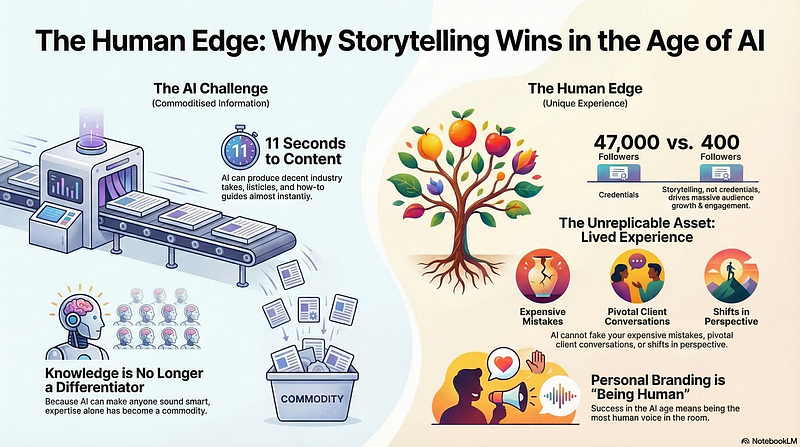
One had 400 followers. The other had 47,000.
I spent the rest of that afternoon trying to figure out why.
It wasn’t the quality of their ideas. Both were sharp. It wasn’t their posting frequency. Both were disciplined. At least in a technical sense, it wasn't their writing skill.
The difference came down to one thing: one of them shared information. The other shared stories.
And in the age of AI, that gap is about to become a canyon.
The World Changed, But Most Personal Brands Didn’t
For the last decade, thought leadership on social media mostly meant being the most informed person in the room. You read more, synthesized faster, and shared your insights before anyone else. That was the game. Being knowledgeable was the moat.
That moat no longer exists.
AI can now produce a well-researched, clearly written LinkedIn post in about 11 seconds. A solid Twitter thread in 30. A 1,500-word newsletter draft in under two minutes. And not just mediocre output. We’re talking about content that is coherent, accurate, reasonably nuanced, and completely indistinguishable from what most people were manually grinding out before.
Which means one uncomfortable truth: if your personal brand is built on being the person who shares valuable information, you’re competing with a tool that never sleeps, never gets writer’s block, and doesn’t need to be paid.
That’s not a scare tactic. This is simply the new reality.
The good news is that there is one thing AI fundamentally cannot do, and it’s the thing that actually makes people follow you, trust you, and remember you.
It cannot live your life.
What AI Can’t Fake
Here’s what I mean.
AI can tell you that 70% of change initiatives fail. It can explain the psychology of resistance, walk you through the Kübler-Ross model, and give you a five-step framework for managing stakeholder alignment.
What it cannot do is tell you about the product launch you led in 2019 that crashed and burned because you ignored the one person on the team who saw it coming. It cannot describe the look on your manager’s face when you had to walk back everything you’d promised. It cannot explain the specific, humbling thing you learned from that moment that rewired how you operate now.
That story is yours. It has texture. It has stakes. It has the kind of earned credibility that no prompt can manufacture.
This is what researchers who study persuasion have known for a long time: information moves the mind, but story moves the person. When you read a statistic, you process it. When you read a story, you experience it. Your brain releases different chemicals. You feel something. That feeling creates a connection.
And connection is what personal branding is actually about.
The Mechanics of Why Story Works
There’s a concept in psychology called “narrative transportation.” When we encounter a well-told story, our brains essentially step inside it. We suspend our critical judgment and start to feel what the protagonist feels.
This is why a compelling case study is more persuasive than a feature list. Why a founder’s origin story moves investors more than a pitch deck. Why you remember the professor who taught through anecdotes long after you’ve forgotten the one who just recited textbook content.
When someone reads your story and thinks, “I’ve felt that exact thing,” something happens that no amount of clever positioning can replicate: they trust you. Not because you told them to. Not because you listed your credentials. But because you made them feel seen.
That’s the foundation every strong personal brand is built on.
Compare that to the experience of reading AI-generated content. Even when it’s good, there’s a flatness to it. A sameness. It’s technically correct, logically sound, occasionally even insightful. But it doesn’t land the same way. It doesn’t feel like it came from anywhere. Because it didn’t.
Your stories come from somewhere specific. From a real moment, a real decision, a real consequence. That specificity is what makes them land.
The Stories Nobody Wants to Tell Are the Ones That Build Brands
Here’s the part most people get wrong.
When I say “tell stories,” I don’t mean share your wins. I don’t mean post the photo from the award ceremony or write about the promotion you just got. Everyone does that, and it creates a very particular kind of personal brand: impressive, polished, and deeply unrelatable.
The stories that actually build audiences are the ones that show the other side.
The decision you got badly wrong. The strategy you were certain about that turned out to be exactly backwards. The moment you realized you’d been operating from a flawed assumption for years. The client conversation that forced you to rethink something fundamental about your work.
These are uncomfortable stories to tell. They require a certain kind of courage, the willingness to look less than perfect in public. But they are the stories that make people stop scrolling. Because everyone in your industry has had those moments. Most of them just aren’t talking about it.
When you do, you immediately become the most interesting person in the room. Not because you failed, but because you’re willing to be honest about it. And that honesty signals something that expertise alone never can: judgment. Self-awareness. Genuine learning over time.
Those are the qualities people want to follow.
What Your Personal Brand Actually Needs to Communicate
A lot of personal branding advice focuses on positioning. Niche down. Pick your lane. Be the go-to person for X.
That advice isn’t wrong, but it misses something.
Positioning tells people what you do. A story tells people who you are. And in a world where the "what" is increasingly commoditized, the "who" is where all the differentiation lives.
Think about the people you genuinely follow. Not the ones you passively see in your feed, but the ones you actually seek out, whose content you look forward to, whose work makes you want to share it. I’d bet that most of them have one thing in common: you feel like you know them. Not just what they think, but how they think. What shaped them? What they care about beyond their professional identity.
That’s what a story does. It gives people context for your ideas. It makes your perspective feel earned rather than performed. It turns a content creator into a person.
And people trust people. They don’t trust personas.
How to Actually Do This
I want to be practical here because this isn’t a new idea. “Be authentic” and “tell your story” are probably the two most repeated pieces of advice in personal branding, and they’re almost always too vague to act on.
So here’s what it actually looks like.
Start with the moments, not the lessons. Most people make the mistake of starting with the insight they want to share and then working backwards to find a story to support it. Flip it. Start by making a list of moments. Specific moments in your career where something shifted. Where you were wrong. Where you were surprised. Where something costs you. The lesson will reveal itself in the telling.
Get specific about the details. The reason stories fail is because they stay too abstract. “I once led a project that didn’t go as planned” is not a story. “We were six weeks from launch when our biggest stakeholder changed the requirements from scratch” is the beginning of one. Specificity creates credibility. It tells the reader, "This event actually happened."
Don’t editorialize too early. Let the reader sit inside the moment before you tell them what to think about it. Describe what happened. Describe what you were feeling, what you thought at the time and what the stakes were. Then step back and reflect. The reflection at the end of a story lands much harder when the reader has already experienced the moment with you.
Make the lesson transferable. The best personal brand stories aren’t just about you. They’re about a truth your reader can apply to their own situation. Your story is the evidence; the insight is the gift. Make sure you’re giving something, not just processing in public.
Post it even when it feels vulnerable. This is the hardest one. There will be stories that feel too revealing, too exposing, too much like admitting weakness. Those are usually the best ones. The editorial filter most of us apply to our content is designed to protect our image. It is also the thing that makes most content forgettable.
The Bigger Picture
We are in the early days of a world where content is infinitely abundant and attention is the scarce resource.
In that world, the people who will build lasting audiences are not the ones who produce the most. They’re not the ones with the sharpest takes or the most comprehensive frameworks. They’re the ones who make their readers feel something. The ones who make people feel less alone in their professional struggles. The ones whose content reads like it came from a real person with a real point of view, shaped by real experience.
That’s not something you can outsource. It’s not something you can scale. It’s not something AI can generate on your behalf.
It’s the one competitive advantage that gets stronger the longer you build it, because the longer you’re in an industry, the more you’ve lived, and the more you’ve lived, the richer your story becomes.
The question isn’t whether storytelling matters in the age of AI.
The question is whether you’re willing to use it.
What’s one experience from your career that changed how you work? Drop it in the comments. I’d genuinely love to read it.
Download my free LinkedIn Profile Audit Guide, your first step toward becoming visible, valuable, and unforgettable on LinkedIn.
Subscribe to my newsletter on SocialJJ.
Follow me on LinkedIn.
Follow me on Twitter.
Follow me on Instagram.