The Search Engine You Built Your Business Around Is Not Working the Way It Used To
And most marketers have not caught up yet.
I have been in digital marketing for 15 years. I have watched Google go from 10 blue links to featured snippets to knowledge panels to AI overviews.
Every shift felt big at the time.
This one is different.
What the numbers are telling us
Recently, I came across three data points that caught my attention.
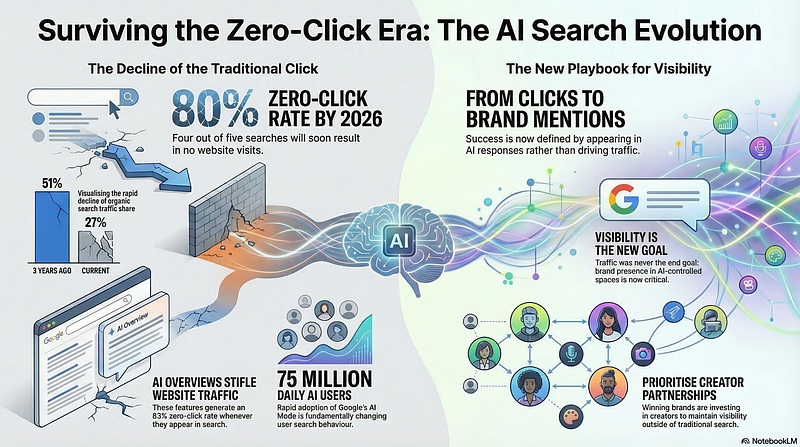
First: 4 out of 5 Google searches now end without a single click to any website. This is not a minor error. That is the majority of all search activity happening without anyone ever landing on a page.
Second: Google’s AI Mode already has 75 million daily active users. This feature launched not long ago, and it is already one of the most used products Google has ever shipped.
Third: The share of website traffic coming from organic search has dropped from 51% to 27% in just three years.
Read that last one again.
Three years ago, more than half of all web traffic came from organic search. Today it is barely a quarter. And it is still falling.
Why this is happening
It is actually pretty simple once you see it.
Google built a search engine to help people find answers. For 25 years, finding the answer meant going to a website. So they sent you to a website.
Now Google can just give you the answer directly.
AI Overviews pull from across the web, synthesize the information, and hand it to you in one clean response. No clicking required. No website visit needed.
From a user experience standpoint, it is genuinely great. You ask a question. You get an answer. Done.
From a marketer’s standpoint, it is a fundamental shift in how visibility works.
What most marketing teams are still doing
Most teams I talk to are still running the same search playbook they have been running for years.
Rank for keywords. Drive traffic. Convert visitors.
That playbook assumed that ranking meant getting clicks. It assumed that visibility and traffic were the same thing.
They are not anymore.
You can rank at position one and still get no clicks if Google’s AI answered the question above your link. The user got what they needed and moved on.
This behavior is not a bug in the system. It is the system working exactly as designed.
What actually works now
The brands that thrive in this environment prioritize something older and more fundamental: being the source that gets cited, rather than focusing on traffic metrics first. They prioritize a more traditional and essential goal: becoming the go-to source for citations.
Think about how AI Overviews work. Google’s AI does not make up answers. It pulls from sources it trusts. It cites brands and websites that have consistently produced accurate, useful, well-structured content.
If the AI cites your content, your brand appears in the answer. Even if no one clicks through.
That is the new visibility. And it requires a different approach than the one most teams are running.
Here are the factors that are truly driving progress:
Publishing original research and data. AI systems love to cite primary sources. If you produce original data, your chances of being referenced inside an AI answer go up significantly.
Writing content that directly answers specific questions. Not vague overview pieces. Specific, structured answers to questions your audience is actually asking.
Building brand recognition outside of search. Partnerships, creator collaborations, community, word of mouth. These channels were always important. They are more important now because they do not depend on Google sending you traffic.
Getting mentioned on sites that AI trusts. Earned media, third-party coverage, and citations from high-authority sources all contribute to whether AI systems treat you as a credible source.
The harder conversation
Here is what I think most marketing leaders need to hear directly.
The traffic metrics you have been reporting to your leadership team may look fine on the surface. Organic traffic might be holding steady.
But the reason it is holding steady might not be because your SEO strategy is working. It might be because you are getting more branded searches, more direct traffic, more referral traffic. Those are covering the decline in non-branded organic.
When you strip those out and look at what is actually coming from Google for informational and commercial searches, the picture often looks different.
I would encourage you to look at that data honestly before you assume the current strategy is holding up.
What I am doing differently
I am spending more time thinking about what it means to be the source of record in my space rather than the destination with the highest-ranking page.
Those are different goals. And they require different investments.
More original thinking. More data. More emphasis on building a brand people recognize before they even open a search bar.
And there should be more focus on metrics that reflect actual business impact, rather than traffic numbers.
The bottom line
Search is not dead. Google is not going anywhere.
But the relationship between search ranking and business outcomes has fundamentally changed. Treating it the same way you did three years ago is going to produce worse results every quarter.
The marketers who adapt to this shift early are going to have a real advantage. Not because they found a clever hack. But because they understood what changed and adjusted their strategy accordingly.
That is the job.
What is your team doing to adapt to AI search? I would genuinely love to hear what is working.
Download my free LinkedIn Profile Audit Guide, your first step toward becoming visible, valuable, and unforgettable on LinkedIn.
Subscribe to my newsletter on SocialJJ.
Follow me on LinkedIn.
Follow me on Twitter.
Follow me on Instagram.